Configuration intake
Send PickupSpec Source Your Pickup Requirement
Use the procurement brief to describe the vehicle duty, exact configuration questions, quantity, destination, delivery window, inspection needs, and documents. A structured first message lets candidate factories respond to the same scope.
Contact and workflow
Written Scope First, Then the Right Channel
- Service coverage
- US business-buyer vehicle sourcing inquiries and destination-specific requirement handoff.
- Replies are sent to the work email provided in the form; no public address is invented for this sourcing service.
- Phone
- A call can be scheduled after the written specification and responsible contact are reviewed.
- Business hours
- Asynchronous intake; response timing and meeting windows are confirmed with the inquiry.
- Social channels
- Procurement requests are handled through this form rather than public social messaging.

What happens next
- We check whether duty, configuration, quantity, and destination are clear.
- Open assumptions are returned as questions before factory outreach.
- Candidate quotes are compared on one Incoterm and evidence scope.
Procurement brief
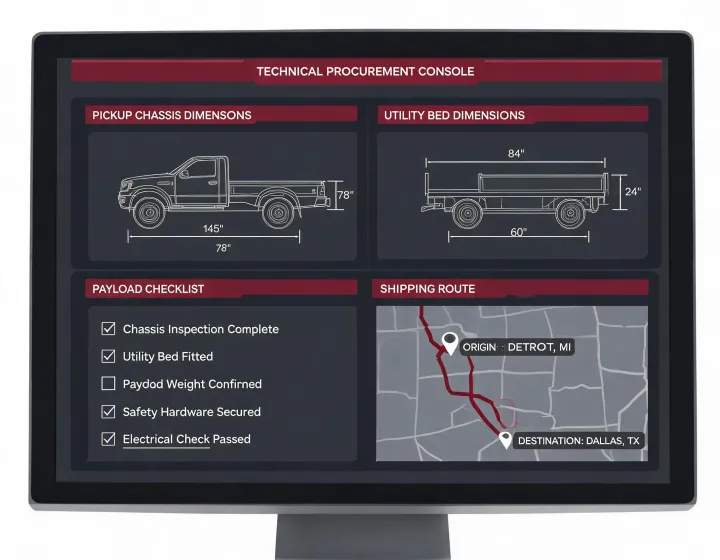
Include cab and bed or body form, wheelbase, powertrain and drivetrain, GVWR/GAWR/GCWR, payload and towing basis, quantity, destination, delivery window, inspection, and document needs. Optional budget and supplier preference help frame alternatives but do not establish a verified supplier tier.
Before relying on a response
Availability, MOQ, final price, lead time, warranty, parts support, ratings, and documents require confirmation for the exact configuration and order. FMVSS, EPA, registration, customs, insurance, and destination approval are separate reviews. A manufacturer specification cited during comparison identifies questions to verify; it does not prove PickupSpec Source holds inventory, authorization, certification, or a supply allocation.
For an electric alternative, distinguish nominal and usable battery capacity, connector, AC/DC charge power, test-cycle basis, operating route, payload, climate, and charging-site constraints. For combustion or hybrid alternatives, identify fuel, transmission, drivetrain, emissions context, duty, and service availability. Every option should use the same cargo, crew, body, trailer, quantity, destination, and commercial boundary.